Last reviewed: October 19, 2026
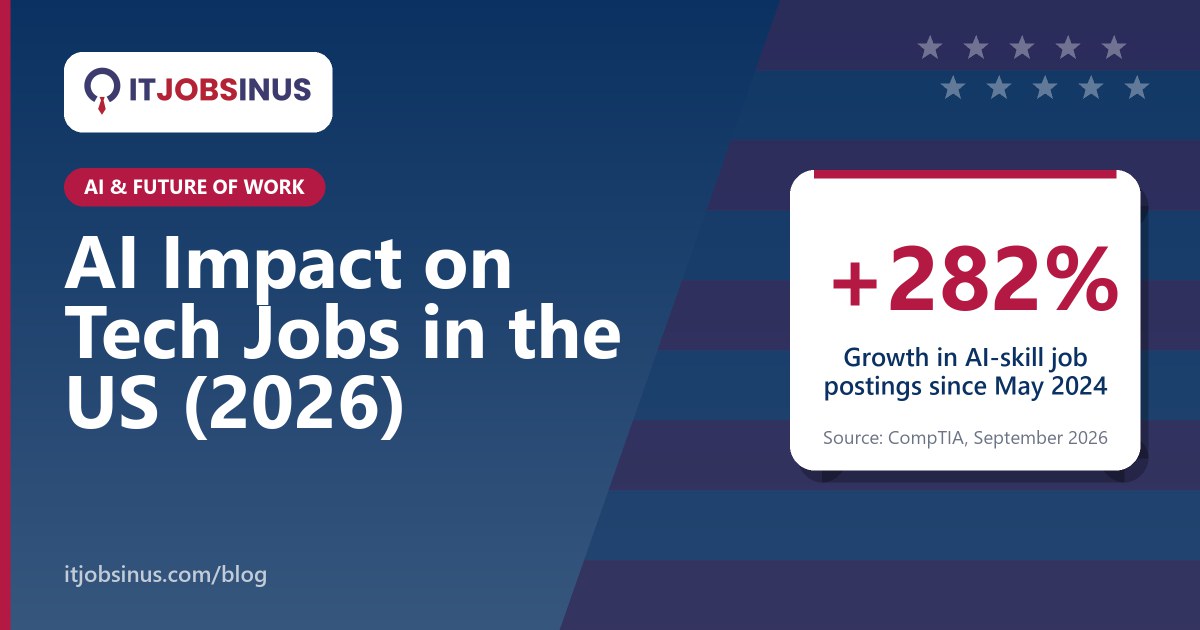
Short answer: the AI impact on tech jobs in the US is a reshuffle, not a collapse. Layoffs are high: 133,217 tech workers had been laid off at 323 companies by October 15, 2026, already more than all of 2025 (Layoffs.fyi), and employers cited AI in more US job cuts than any other reason this year. But demand is shifting, not disappearing. Active IT job postings reached 625,633 in September 2026, the highest in more than three years, and postings requiring AI skills are up 282% since May 2024 (CompTIA). Tech unemployment was just 3.3%.
Key takeaways
- 133,217 tech layoffs in 2026 through October 15, more than all of 2025 (Layoffs.fyi).
- Active IT job postings: 625,633 in September 2026, a three-year high (CompTIA).
- Postings requiring AI skills: 349,821, up 282% since May 2024.
- Tech unemployment: 3.3% vs. 4.2% nationally (September 2026).
- US software development postings on Indeed are still 22% below February 2020 but 21% higher than a year earlier.
Partly. Big tech companies are cutting staff while spending heavily on AI infrastructure. Oracle, Amazon, Dell and Meta account for some of the largest 2026 cuts. Many announcements explicitly tie layoffs to AI investment or to "flattening" teams as AI tools raise productivity. Employers named AI as a reason in more than 116,000 US job cuts through August 2026, making it the top cited reason this year.
But layoffs are only half the picture. While the tech sector itself shed roles, employers across banking, healthcare, retail, government and manufacturing kept hiring tech talent. That's why active postings hit a three-year high in the same month.
| Exposure | Roles | Why |
|---|---|---|
| Higher | Entry-level coding, manual QA testing, basic tech support, technical writing, routine data work | AI can now do a usable first draft of these tasks |
| Changing | Software engineers, data analysts, product managers, business analysts | AI speeds up delivery; system design, judgment and ownership matter more |
| Growing | AI/ML engineers, data engineers, cloud and DevOps, cybersecurity, AI governance and security | Companies need people to build, run and secure AI systems |
Junior roles used to be where companies trained people on simple tasks. AI coding assistants now handle many of those tasks, so some teams hire fewer juniors and expect new hires to contribute faster. Software development postings have recovered strongly in the past year, but they're still below pre-pandemic levels, so competition for entry-level roles remains tough.
Create a free ITjobsinUS account, then browse the latest IT jobs in the USA, including software development and data science jobs.
ðŸ·ï¸ Tags
â“ Frequently Asked Questions
Q1: Is AI causing tech layoffs in the US?
Partly. Employers cited AI in more US job cuts than any other reason in 2026, and 133,217 tech workers were laid off by October 15, 2026, according to Layoffs.fyi. But overall IT job postings still hit a three-year high.
Q2: Are tech jobs growing or shrinking in 2026?
Both. Tech companies are cutting staff, but active IT job postings reached 625,633 in September 2026, the highest in over three years, as other industries hire tech talent, according to CompTIA.
Q3: What is the tech unemployment rate in the US?
Tech unemployment was 3.3% in September 2026, below the national rate of 4.2%, according to CompTIA.
Q4: Which tech jobs are most at risk from AI?
Entry-level coding, manual QA testing, basic tech support, technical writing and routine data work are the most exposed to AI.
Q5: How fast is demand for AI skills growing?
Active job postings requiring AI-related skills reached 349,821 in September 2026, up about 282% since May 2024, according to CompTIA.
Q6: Is it still worth becoming a software engineer?
Yes. Software developers remain the most in-demand tech role, and BLS projects 10% growth from 2025 to 2035. But new engineers need strong fundamentals and AI skills to stand out.
Author
Research-based career guidance for technology professionals in the United States.